

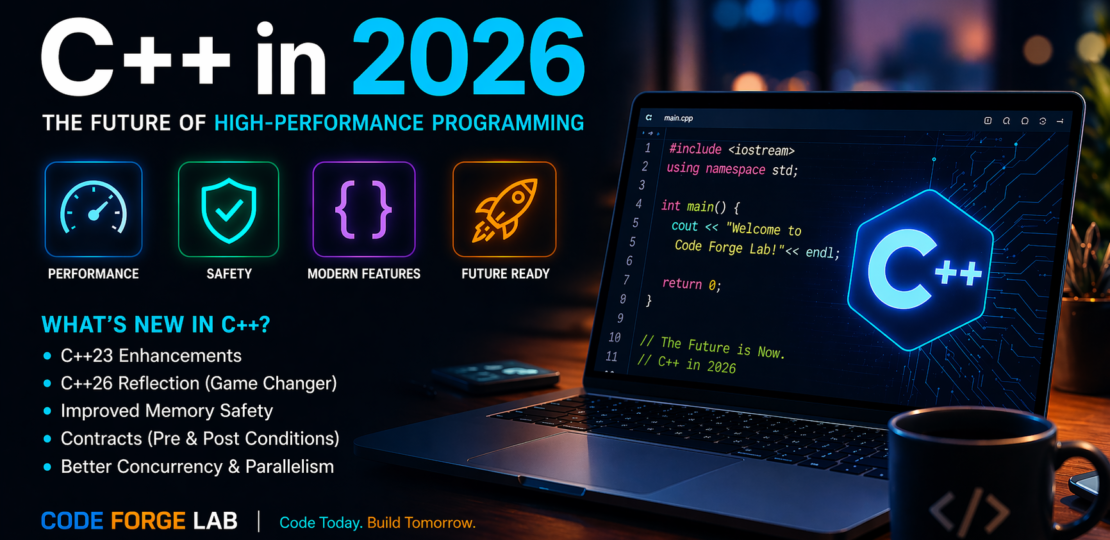
Welcome to C++ in 2026 – The Future of High-Performance Programming
April 23, 2026 | by Admin
Introduction
C++ is not just alive — it’s evolving faster than ever.
With the release of C++23 and the upcoming C++26 standard, the language is becoming more powerful, safer, and easier to use. If you’re starting your journey or already coding in C++, this is the perfect time to dive in.
In this blog, we’ll cover:
- What C++ is
- Why it’s still important in 2026
- Latest updates (C++23 & C++26)
- Your roadmap to start learning
What is C++?
C++ is a high-performance programming language used in:
- Game development
- System programming
- Embedded systems
- High-frequency trading
- Backend systems
It gives developers full control over memory and performance, which makes it one of the most powerful languages even today.
Why Learn C++ in 2026?
Here’s why C++ is still a top choice:
✔️ Ultra-fast performance
✔️ Used in AAA games & real-time systems
✔️ Strong demand in industry
✔️ Foundation for other languages (Java, Python internals, etc.)
Even today, C/C++ dominate performance-critical systems and parallel computing environments.
Latest C++ News (2026 Updates)
1. C++26 is Almost Here
The biggest news:
C++26 is officially completed and moving toward final release
Key features:
- Static Reflection (Game changer)
- Improved Memory Safety
- Contracts (preconditions & postconditions)
- Better Concurrency & Parallelism
Reflection alone is considered a “transformational feature” for the language
2. C++23 Support is Growing
- Full compiler support is being finalized in Visual Studio 2026
- New features like improved
constexpr, better standard libraries
Microsoft is actively rolling out C++23 support in new build tools
3. Smarter Tooling & Performance
- Faster compilers ⚡
- Better debugging tools
- AI-assisted coding (in modern IDEs)
New toolchains are improving performance and developer productivity significantly
Your First C++ Program
Let’s start simple
#include <iostream>
using namespace std;

int main() {
    cout << "Welcome to Code Forge Lab!" << endl;
    return 0;
}
Explanation:
#include <iostream>→ Input/Output librarymain()→ Entry point of programcout→ Print output
How to Start Learning C++
Step-by-Step Roadmap:
- Learn Basics
- Variables, loops, conditions
- Understand OOP
- Classes, objects, inheritance
- Practice Data Structures
- Arrays, linked lists, stacks
- Build Projects
- Calculator
- Student management system
- Mini game
What You’ll Learn Next on Code Forge Lab
Upcoming posts:
- C++ Basics for Beginners (Complete Guide)
- OOP in C++ Explained Simply
- Top 10 C++ Interview Questions
- Build Your First Project in C++
Final Thoughts
C++ is not just a language — it’s a power tool.
With upcoming features like reflection and safer programming, the future of C++ looks stronger than ever.
If you want performance + control + career growth → Learn C++
RELATED POSTS
View all